
Artificial intelligence can sound complicated, expensive and designed mainly for large companies.
In practice, many small businesses do not need a complex AI platform. They need simple tools that solve everyday problems:
Too many repetitive messages.
In practice, many small businesses do not need a complex AI platform. They need simple tools that solve everyday problems:
Too many repetitive messages.
- Missed enquiries outside business hours.
- Appointment requests arriving through different channels.
- Customer information collected manually.
- Administrative tasks that consume valuable time.
- Websites that do not generate enquiries or help customers take action.
The objective of business automation is not to replace people. It is to reduce repetitive work so that the team can focus on customers, decisions and tasks that require human attention.
A WhatsApp assistant that works beyond office hours
For many businesses, WhatsApp is already the main communication channel.
Customers use it to ask about:
Opening hours.
A WhatsApp assistant that works beyond office hours
For many businesses, WhatsApp is already the main communication channel.
Customers use it to ask about:
Opening hours.
- Prices and services.
- Appointments.
- Availability.
- Maintenance issues.
- Required documents.
- Order status.
- Urgent contact details.
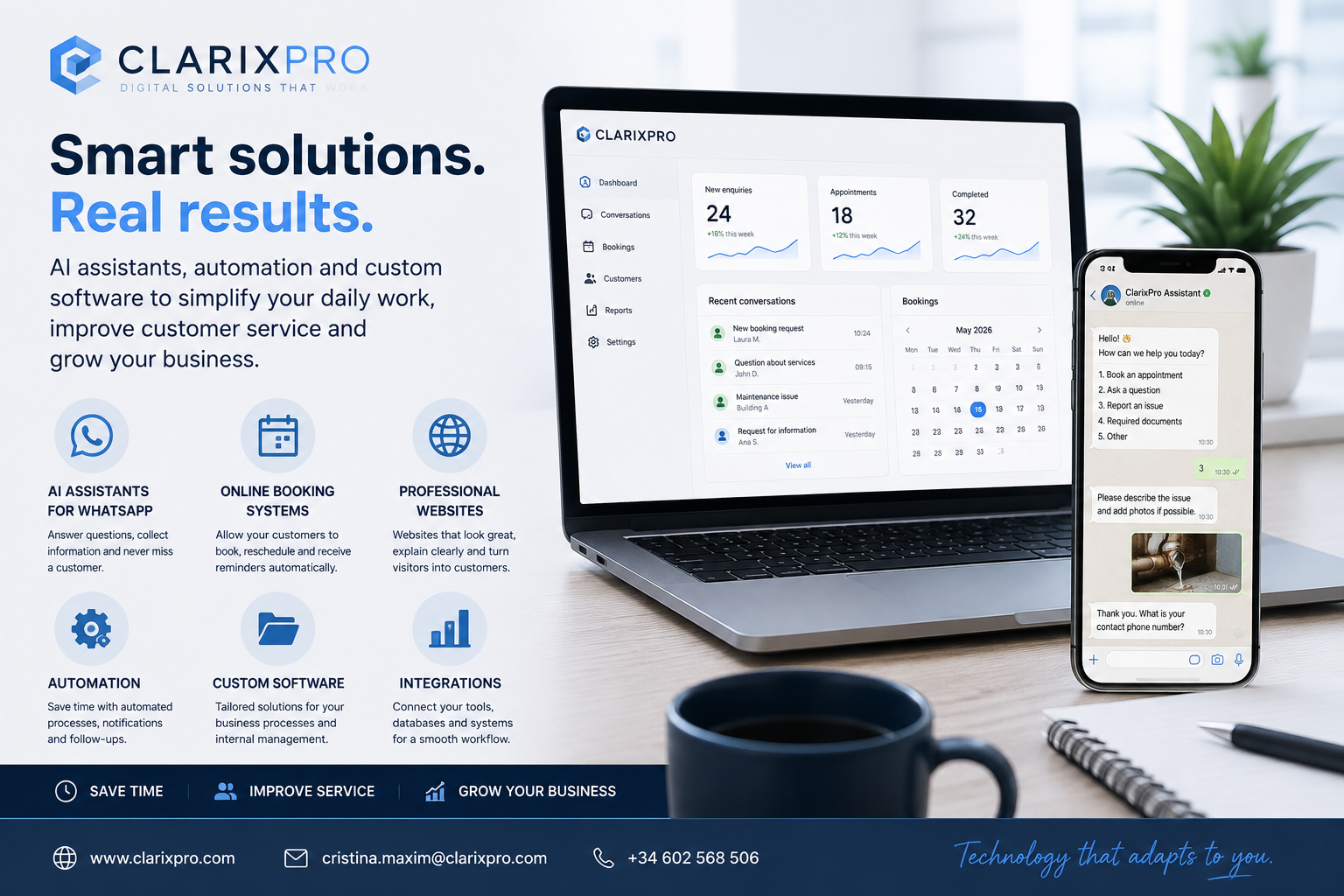
An AI-powered WhatsApp assistant can answer common questions, collect the necessary information and organise each request before it reaches the team.
For example, it can ask for:
Name and contact details.
For example, it can ask for:
Name and contact details.
- Type of service required.
- Preferred appointment date.
- Address or location.
- Photographs and documents.
- Additional information needed by the business.
The company receives a clearer and more complete request instead of an isolated message with missing information.
Online booking without unnecessary calls
Appointment-based businesses often lose time managing calls, cancellations and changes.
A website with an integrated booking system allows customers to:
Check available times.
Online booking without unnecessary calls
Appointment-based businesses often lose time managing calls, cancellations and changes.
A website with an integrated booking system allows customers to:
Check available times.
- Request or book appointments.
- Receive confirmation.
- Reschedule when permitted.
- Receive automatic reminders.
This can be particularly useful for clinics, physiotherapy centres, veterinary practices, beauty businesses, consultants and other service providers.
The booking process can also be connected to WhatsApp, email or an internal calendar.
A website that performs a real function
A company website should do more than display a logo, photographs and a list of services.
A practical business website can:
Explain services clearly.
The booking process can also be connected to WhatsApp, email or an internal calendar.
A website that performs a real function
A company website should do more than display a logo, photographs and a list of services.
A practical business website can:
Explain services clearly.
- Answer frequent questions.
- Generate qualified enquiries.
- Collect customer information.
- Book appointments.
- Direct visitors to the correct department.
- Provide access to documents or private areas.
- Connect with WhatsApp and other business tools.
The best website is not necessarily the largest or most expensive. It is the one that makes it easier for the customer to take the next step.
Automating enquiries and administrative processes
Many businesses still copy information manually between email, spreadsheets, forms and internal systems.
Automation can help with tasks such as:
Sending form submissions to the correct employee.
Automating enquiries and administrative processes
Many businesses still copy information manually between email, spreadsheets, forms and internal systems.
Automation can help with tasks such as:
Sending form submissions to the correct employee.
- Creating structured customer records.
- Organising maintenance or service requests.
- Sending reminders.
- Following up on unanswered enquiries.
- Requesting missing documents.
- Notifying customers when the status of a request changes.
- Generating summaries for the team.
- Connecting calendars, email, WhatsApp and databases.
Even a small automation can save several hours each week when it removes a task that is repeated every day.
Custom software for processes that standard tools cannot solve
Sometimes a business has a specific workflow that cannot be managed effectively with standard software.
In these cases, custom development may be appropriate.
A tailored solution could include:
Internal management dashboards.
Custom software for processes that standard tools cannot solve
Sometimes a business has a specific workflow that cannot be managed effectively with standard software.
In these cases, custom development may be appropriate.
A tailored solution could include:
Internal management dashboards.
- Customer or owner portals.
- Document management systems.
- Supplier tracking.
- Incident management.
- Quotation tools.
- Lead qualification.
- Staff knowledge assistants.
- Reporting and analytics.
- Integrations with existing databases or platforms.
Custom software should be developed around a real operational need. Technology is useful when it simplifies the business, not when it creates another complicated system to manage.
Which businesses can benefit?
Practical AI and automation can be adapted to many sectors, including:
Property management companies.
Which businesses can benefit?
Practical AI and automation can be adapted to many sectors, including:
Property management companies.
- Veterinary clinics.
- Physiotherapy centres.
- Dental and medical clinics.
- Hotels and holiday accommodation.
- Accounting and tax firms.
- Renovation and maintenance companies.
- Beauty and wellness businesses.
- Real estate agencies.
- Professional service companies.
The ideal solution is different for every sector. A veterinary clinic may need appointments and frequently asked questions, while a property management company may need structured maintenance reports with addresses and photographs.
Start with one specific problem
A common mistake is trying to automate the entire company at once.
A better approach is to begin with one process that is:
Repetitive.
Start with one specific problem
A common mistake is trying to automate the entire company at once.
A better approach is to begin with one process that is:
Repetitive.
- Time-consuming.
- Easy to measure.
- Frustrating for staff or customers.
- Important enough to justify improvement.
Examples include:
Collecting appointment requests.
Collecting appointment requests.
- Receiving complete maintenance reports.
- Answering frequent questions.
- Following up on new enquiries.
- Requesting customer documents.
Once the first process is working correctly, additional functions can be added gradually.
Practical technology for real businesses
At ClarixPro, we develop digital solutions adapted to the way each business actually works.
Our services include:
Practical technology for real businesses
At ClarixPro, we develop digital solutions adapted to the way each business actually works.
Our services include:
- AI assistants for WhatsApp and websites.
- Professional business websites.
- Online booking systems.
- Process automation.
- Customer and document portals.
- Integrations with existing tools.
- Custom software and internal platforms.
The goal is simple: fewer repetitive tasks, faster responses and better-organised business processes.
Would you like to see a practical example?
We can prepare a demonstration based on your sector and show how a real customer enquiry could be managed automatically.
Contact ClarixPro
Would you like to see a practical example?
We can prepare a demonstration based on your sector and show how a real customer enquiry could be managed automatically.
Contact ClarixPro